
LINKNET™ has been designed to efficiently store power system networks and various solution matrices in computer memory.
- Processing of network information is facilitated; e.g. branches and nodes connected to a given node are easily scanned.
- The structure easily and rapidly facilitates network changes; e.g. the addition and removal of branches.
- The structure is easy to program in a variety of programming languages.
The structure derives its name from linked-lists which are record how branch end points are connected to various nodes.
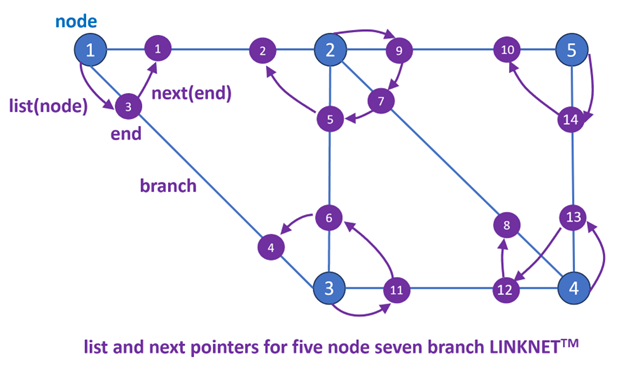
LINKNET™ is well suited to implementing solution techniques such as Tinney Scheme II Optimal Ordering for sparse factorization. The insight gained from representing sparse factorization as a series of Kron reductions on power system models, has led to innovative methods for dynamic equivalents, parallel processing with GPUs and unbalanced power flows.
Applications of LINKNET™
1970’s
- Gauss-Siedel Power Flow
- Sparse power matrix factorization and forward / backward processing.
- Security Constrained Economic Dispatch
- Loss Factors for Economic Dispatch
- Generalized Unbalanced Fault Analysis
- Harmonic Analysis of Ripple Control Schemes of Space Heaters
- Transient Stability Analysis for tuning Power System Stabilizers
1980’s
- Coherency Based Dynamic Equivalents (EPRI)
1990’s – 2010’s
- Linear Power Flow
- Topology Analysis
- Decoupled Power Flow
- State Estimator
- Contingency Analysis
- Topology Switching for Congestion
- System Restoration Navigator (EPRI)
- Network Model Reduction
2020’s
- Geography-Based power system models for Research, and Operator Training.
- Security Constrained Economic Dispatch
- Three Phase Unbalanced Power Flow
- Parallel Processing Power Flow and Transient Stability with GPUs.
- Transient Stability Analysis for System operator training
Languages supported include: Python, Java, SQL, Visual Basic and FORTRAN.
The programs produced with LINKNET™ are very compact, easy to learn and especially easy to modify.